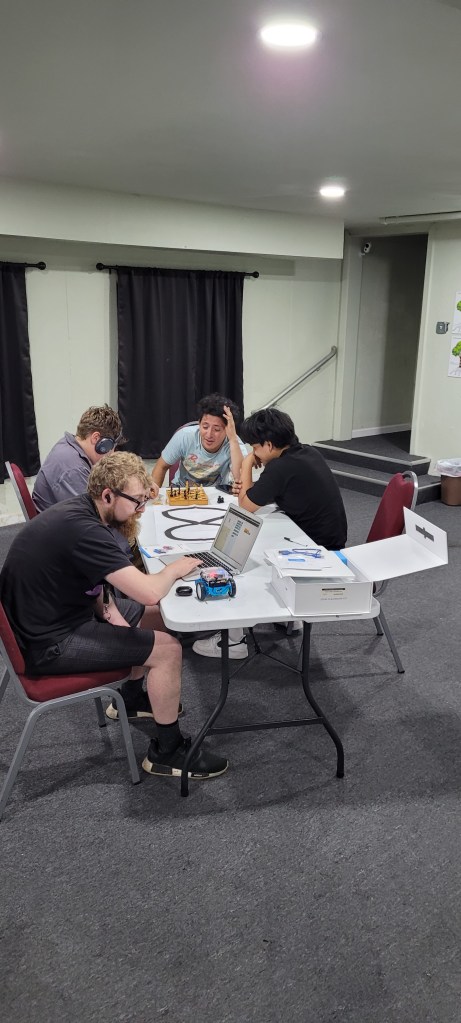
It is hard to articulate the sense of satisfaction when you see youngster learning and having a good time. More so when you know that some of them are having a rough life. These months we have been exploring opportunities to serve our community. From Woodburn in collaboration with Chemeketa College Woodburn Center (Thanks to the unwavering support of Dean Elias Villegas) to The Hope Center PDX (Thanks to Gwenna, Scott, and Kelly) in the neighborhood of Rockwood in Gresham. The picture below shows a small group where one is learning coding using a robot that he assembled and the others learning the game of chess.
At the same time The Hub has been making connections for collaboration with other organization. To name a few BestHQ, MindsMatterPDX, Portland Metro STEM Partnership, Oregon MESA, STREAM-N Team, and iUrbanTeen, and private like CodeNinjas.
Switching gears, lets talk about leadership.
What is the success and longevity of leadership styles? Every corporation has its own culture and therefore their own leadership style. From authoritarian, paternalistic derived from the family who initiated the organization, through democratic based on an executive committee or board, to a servant model where the leader is one who serves the community. Each style has its benefits and downfalls. For one is the easiness or difficulty to implement desired actions. The Religious Society of Friend (known as Quakers) have in their culture the idea of consensus. If one, only one, doesn’t agree with the proposal, the proposal doesn’t fly! It is hard to move on and it takes a long time for consensus to be build. But in the long run it helps the community to be build in very solid ground. On the other hand we have authoritarian systems where things get done regardless of the opinion of its members, the dictator has the only word that matters. It may be efficient but, normally, it doesn’t last very long.
Now let’s see how a servant leader can run the show. Without knowing how the leader got there, through family inheritance, because s/he was one of the founders, or by appointment of the executive committee/board, this leader knows that it is not about her/him, s/he is working for a cause that is greater than her/him. For the servant leader, the purpose of leadership is based on the mission of the organization, it means that her/his actions will transcend the moment and will create a sustainable atmosphere.
Over thirty-five years ago, I, with a few colleagues organized a group of Earth Scientist under the name Instituto Nacional de Geoquímica https://www.inageq.com/. As a scientific association it has members who elect the leadership of the organization. This year’s annual conference will be held in Ensenada Baja California Mexico. https://www.inageq.com/congreso-nacional-2025. At the time, members decided that if one donated the equivalent of 10 years of membership dues, a life-time membership would be granted. That is how founding members got the association started. Looking back it gives great satisfaction to see how INAGEQ is thriving.
35 years is a long time, but someone will be here to witness how The Hub will be thriving. But let’s focus back on the present. Now we have to decide how our membership will be organized. What kind of members and what is the characteristic of a “voting” member? It is stated in our Bylaws that there is only one kind of voting members, even though other types of members can be defined by the Board.
Raise your hand if you think this blog was written for you!
Yes, we need to take it personal, we need to get involved as this project belongs to all of us. The success (or failure) depends on all of us!
 STEAM Hub 4 CISS
Leave a comment